Connecting the past and future: the role of the pre-commissural fornix in episodic autobiographical memory and simulation
Abstract
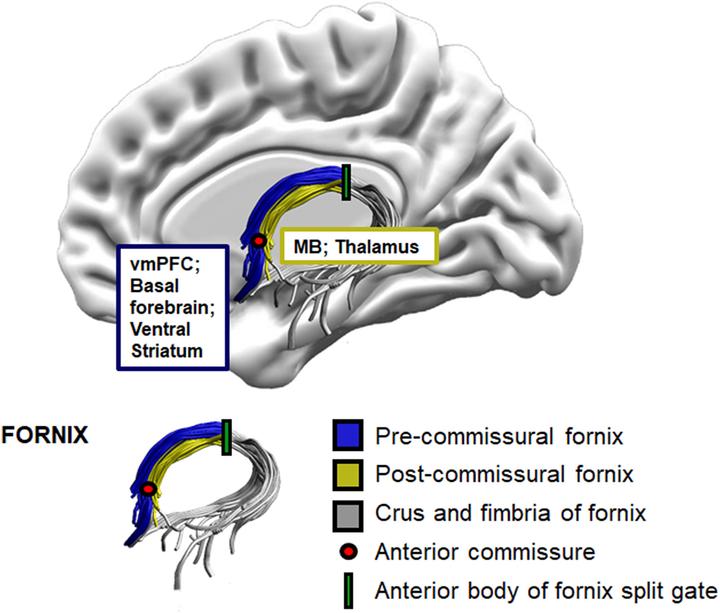
Neuropsychological and functional magnetic resonance imaging (MRI) evidence suggests that the ability to vividly remember our personal past, and imagine future scenarios, involves two closely connected regions: the hippocampus and ventromedial prefrontal cortex (vmPFC). Despite evidence of a direct anatomical connection from anterior hippocampus to vmPFC, formed via the fornix, it is unknown whether hippocampal-vmPFC structural connectivity supports both past and future-oriented episodic thinking. To address this, we applied diffusion-weighted magnetic resonance imaging (dMRI) and a novel deterministic tractography protocol to reconstruct distinct subdivisions of the fornix previously detected in axonal tracer studies, namely pre-commissural (connecting the anterior hippocampus to vmPFC) and post-commissural (linking the posterior hippocampus and medial diencephalon) fornix, in a group of healthy individuals who undertook an adapted past-future autobiographical interview. As predicted, we found that inter-individual differences in pre-commissural - but not post-commissural - fornix microstructure (fractional anisotropy) was significantly correlated with the episodic richness of both past and future autobiographical narratives. Notably, these results remained significant when controlling for both non-episodic narrative content and grey matter volumes of the hippocampus and vmPFC. This study provides novel evidence that reconstructing events from one’s personal past, and constructing possible future events, involves a distinct, structurally-instantiated hippocampal-vmPFC pathway.