Thinking outside the box: a new role for hippocampal subfields in boundary extension
Abstract
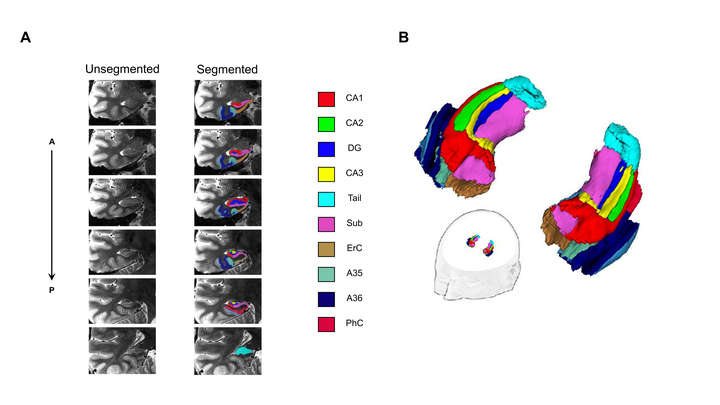
Boundary extension (BE) is a memory error in which healthy participants construct an internal representation that extends beyond the borders of a scene. For instance, when two identical scenes are presented sequentially, participants will often indicate that the second scene appears closer-up than the first identical scene, suggesting that they have extended the scene borders of the initial presentation. This cognitive phenomenon is considered adaptive, facilitating the integration of discrete scene views into coherent spatial representations - a function thought to depend on the human hippocampus (Hodgetts et al., 2017; Zeidman & Maguire, 2016). While there is evidence that amnesic patients with reduced hippocampal volume exhibit reduced BE relative to controls, little is known about which of the various sub-regions (CA1, CA2, CA3, DG & subiculum) within the hippocampus might contribute to this phenomenon. To address this question, we scanned 90 young adults using a 7T ultra-high-resolution imaging sequence with an effective in-plane resolution of 0.2 x 0.2 mm (aged 25-27 years, 44 female). This sequence allowed CA1, CA2, CA3, DG and subiculum to be structurally delineated along the whole hippocampus. Participants were recruited as part of a larger study, investigating genetics, scene perception, and memory. Outside the scanner, these participants undertook a rapid serial visual presentation BE task, in which pairs of identical scenes were presented sequentially (Mullally et al., 2012; De Luca et al., 2018). Participants were required to indicate whether, compared to the original scene, the second picture seemed closer-up, the same, or farther away. A multiple regression model, taking account of intracranial volume, revealed that DG and CA3 volumes were predictors of BE (DG: t(72) = 3.084, p = 0.003, β = 0.472, sr = 0.33; CA3: t(72) = 3.112, p = 0.003, β = -0.469, sr = -0.33). Specifically, larger left CA3 volume and smaller left DG volume was associated with greater BE. These findings highlight a potential role for the DG and CA3 hippocampal subfields in online scene construction, consistent with imaging and neuropsychological work implicating the hippocampus in this memory phenomenon. This study provides novel insights into the hippocampal sub-regional contributions to boundary extension, and highlights the potential of 7T ultra-high-resolution imaging for refining existing models of human hippocampal function.